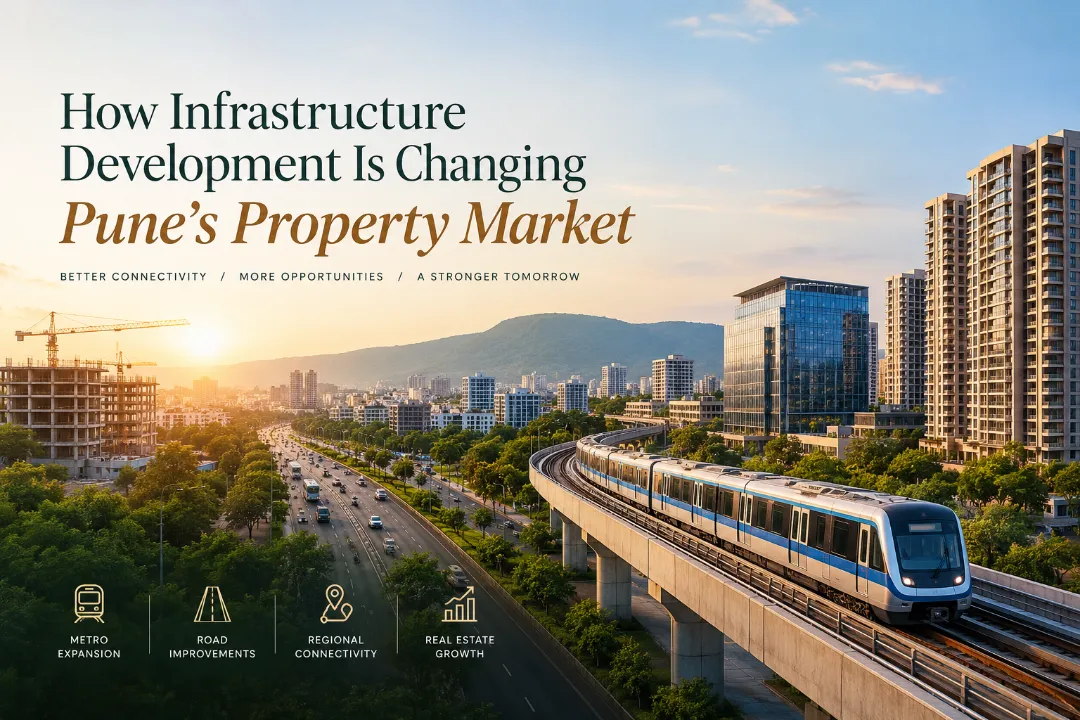
How Infrastructure Development Is Changing Pune’s Property Market
Pune has evolved from a traditional educational and IT hub into one of India’s fastest-growing urban markets. Alongside residential and commercial expansion, large-scale infrastructure development is reshaping how people travel, work, invest, and choose property locations.
From metro corridors and road upgrades to ring-road projects and improved connectivity to major employment hubs, infrastructure is increasingly becoming a key factor influencing Pune’s real estate market.
1. Better Connectivity Is Expanding Property Demand
Connectivity has always played an important role in real estate. As Pune’s road and public-transport networks improve, previously less-connected locations can become more accessible to residential and commercial users.
Areas with improved access to major roads, metro stations, business districts, and transport corridors can attract greater interest from homebuyers, tenants, and businesses.
The key change is that buyers are no longer looking only at the property itself. They are increasingly considering how easily the property connects to the rest of the city.
2. Metro Development Is Influencing Location Preferences
Pune’s expanding metro network is creating new public-transport connections across important parts of the city.
For residents, metro connectivity can mean easier access to workplaces, educational institutions, shopping destinations, and other urban centres. For businesses, locations close to mass-transit infrastructure can provide better accessibility for employees and customers.
As the network expands, properties within convenient reach of metro corridors and stations may receive increased attention from the market.
3. Road Infrastructure Is Supporting Peripheral Growth
Pune’s rapid expansion has pushed development beyond traditional city centres. Improvements to highways, arterial roads, bridges, and planned connectivity corridors are helping connect peripheral areas with established urban zones.
This can create opportunities for residential development, commercial activity, and larger-format projects in emerging locations.
For investors and developers, infrastructure can therefore be an important indicator when evaluating areas that are still undergoing urbanisation.
4. The Ring Road Could Reshape Pune’s Growth Pattern
The proposed Pune Ring Road is one of the major infrastructure initiatives being watched by the real estate sector.
A ring-road network can improve connectivity between peripheral areas while reducing dependence on heavily congested inner-city routes. Better regional connectivity can also support the development of new residential, commercial, and industrial pockets.
However, infrastructure projects should be evaluated based on their actual progress, approved alignment, timelines, and eventual connectivity rather than relying solely on future expectations.
5. Commercial Real Estate Is Benefiting From Improved Access
Infrastructure development is not only changing residential markets. Pune’s commercial real estate landscape is also being influenced by connectivity.
Business districts with access to major roads, metro networks, airports, and established residential catchments can become more attractive for offices, retail, hospitality, healthcare, and other businesses.
For retail and commercial properties, visibility + accessibility + surrounding development can significantly influence the long-term potential of a location.
6. Infrastructure Can Create New Real Estate Micro-Markets
One of the biggest effects of infrastructure development is the creation of new real estate micro-markets.
When a new transport connection improves accessibility to an area, developers may follow with residential projects, retail spaces, offices, schools, and other facilities.
Over time, this can transform an area from a relatively peripheral location into an established urban destination.
This is why infrastructure planning is increasingly becoming part of location analysis for Pune property buyers and investors.
7. Rental Markets Can Also Be Affected
Improved connectivity can influence rental demand, particularly in locations close to employment centres and transportation networks.
Professionals often consider commute time when choosing where to rent. Better connectivity can therefore make certain neighbourhoods more practical for tenants who want access to major employment corridors without living directly in the city centre.
For property owners, this can make accessibility an important factor when evaluating rental potential.
8. Infrastructure Alone Does Not Guarantee Property Appreciation
It is important to separate infrastructure development from guaranteed price growth.
A proposed road, metro station, or transport corridor does not automatically mean that property prices will increase. Actual impact depends on several factors, including:
- Project completion and operational status
- Quality of connectivity
- Existing and future employment opportunities
- Social infrastructure
- Supply and demand
- Local development regulations
- Property quality and pricing
- Accessibility to everyday amenities
Therefore, infrastructure should be considered as one part of a broader real estate analysis.
9. What Buyers Should Look For
For homebuyers evaluating Pune properties, infrastructure can be assessed through a practical checklist:
Connectivity: How easily can you reach major roads, workplaces, schools, and public transport?
Travel Time: What is the realistic commute during peak hours?
Infrastructure Status: Is the project operational, under construction, approved, or only proposed?
Social Infrastructure: Are hospitals, schools, shopping areas, and everyday amenities available nearby?
Future Development: What planned infrastructure and development is expected around the location?
Price vs. Accessibility: Does the property's price make sense compared with its connectivity and surrounding development?
10. What This Means for Pune’s Property Market
Pune’s infrastructure growth is gradually changing the geography of real estate demand.
Instead of being concentrated around established neighbourhoods alone, development is increasingly spreading toward locations that offer better connectivity, employment access, and future urban infrastructure.
The result is a property market where location is becoming more closely connected with infrastructure.
For buyers, this means looking beyond the apartment, plot, or commercial space itself. For investors, it means studying the broader development story of the surrounding area.
Conclusion
Infrastructure is becoming one of the important forces shaping Pune’s real estate market. Metro expansion, road improvements, regional connectivity projects, and growing employment corridors are influencing where people live, work, rent, and invest.
However, successful property decisions require more than simply identifying an upcoming infrastructure project. The most useful approach is to evaluate current connectivity, confirmed infrastructure, employment growth, amenities, supply, pricing, and long-term development potential together.
As Pune continues to expand, the relationship between infrastructure and real estate is likely to remain an important factor in determining how the city’s property landscape evolves.